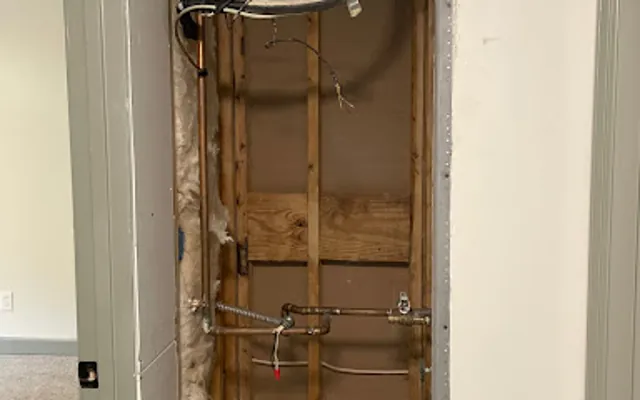
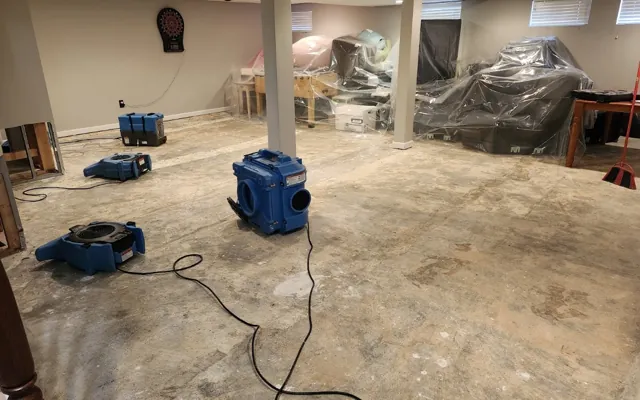
When a supply line fails in a North End, ID basement, local crews respond quickly to stop the water, extract it, and dry the structure using IICRC-standard methods to prevent deeper damage in these historic homes.

Crews first secure the water source at the main or a local valve. They then use extractors to remove standing water from the basement floor before it wicks up into woodwork or migrates under the subfloor.
Using moisture meters, technicians map how far the water traveled into walls, behind base cabinets, and into the subfloor. They open cavities where water is trapped to allow for proper drying of the historic framing.
Air movers and dehumidifiers are placed to dry the structure. Technicians take regular moisture readings, tracking each area until it meets a strict, documented dry standard suitable for North End's older construction.

Supply line failure cleanup in North End typically runs $1,200 to $6,500, depending on how long the line ran, how far the water spread, and whether it reached cabinets, subfloor, or a room below. A line that failed unattended costs far more than one caught quickly. Crews document the failure and moisture readings so a sudden covered loss is clearly supported for the carrier.
In the North End, Boise's oldest residential neighborhood, many early-1900s bungalows have full basements with original galvanized plumbing behind plaster walls. A sudden supply line failure here can send water through floor cavities and into the foundation, quickly damaging irreplaceable woodwork and finishes common in these Craftsman homes. In North End, ID, hard winter freezes stress aging galvanized lines, while spring snowmelt can raise the water table, causing seepage. Many homes also have mature tree roots that can compromise old sewer laterals, making supply line and drainage issues a persistent local concern. From North End, crews also cover nearby East End, West End, Boise Heights, Lusk District, South Boise Village, Central Bench. See every neighborhood and town on the full service area page.
See all areas servedEvery loss is photographed, measured, and logged from the first visit, so the paperwork holds up with the insurance carrier.
Technicians follow recognized IICRC drying standards and prove it with daily moisture readings on North End homes, not guesswork.
Emergency dispatch any hour of the day or night, with a real crew on the way across the valley, not a callback in the morning.
A real crew dispatched any hour, not a callback in the morning.
Trained technicians following recognized IICRC drying standards.
Truck-mounted, portable, and submersible for any size loss.
The loss is documented and billed to the carrier directly.
Drying times in North End, ID basements with plaster and old wood can take 3 to 5 days. The crew's goal is a verified dry standard, not a rushed timeline, to prevent mold in the porous materials common in these historic houses.
Cost depends on how long the line ran and how far water spread into cabinets, subfloor, or a room below. In North End, a quickly caught leak may cost less, while one that saturates a basement and subfloor will be toward the higher end of typical local ranges.
Crews are on call 24 hours a day and can be on the way to North End within the hour.
Call (208) 269-9151